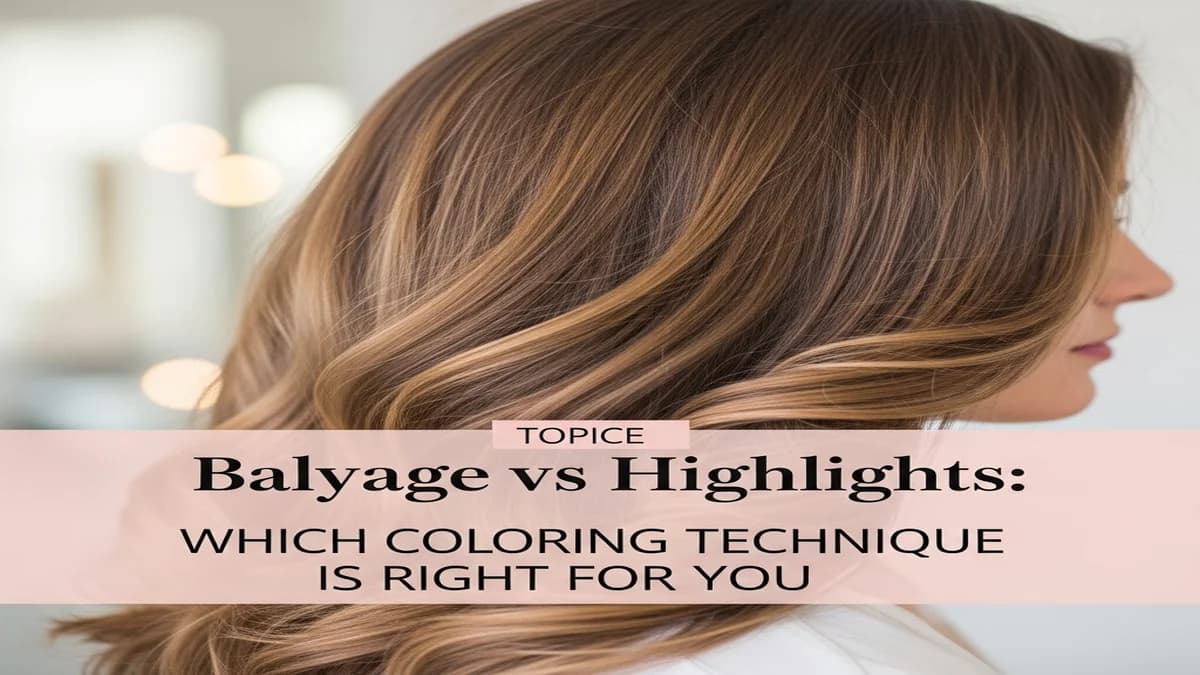
Balayage vs Highlights: Which Coloring Technique Is Right for You?
Balayage vs highlights is one of the most common questions clients bring to their colorists. Both techniques add dimension and lightness to your hair, but they produce distinctly different results, require different maintenance schedules, and suit different hair goals. Understanding the differences before your appointment ensures you get exactly the result you are envisioning.
This comprehensive comparison covers everything from technique and cost to maintenance and results, helping you make the right choice.
What Is Balayage?
Balayage is a French word meaning "to sweep." It is a freehand hair coloring technique where the colorist hand-paints lightener directly onto the hair surface without using foils. The result is a natural, sun-kissed gradient that is lighter at the ends and darker at the roots.
Key characteristics of balayage:
- Hand-painted, freehand application
- No foils used (or minimal foils for certain sections)
- Creates a gradient effect (darker roots blending to lighter ends)
- Looks like natural, sun-kissed lightening
- Soft, blended transitions with no harsh lines
- Customized placement based on your face shape and features
The artistic element: Because balayage is freehand, the result depends heavily on the colorist's skill and artistic eye. A great balayage colorist places light strategically around the face, through the mid-lengths, and at the ends to create a natural, dimensional effect.
What Are Traditional Highlights?
Traditional highlights (also called foil highlights) involve separating thin sections of hair, applying lightener to each section, and wrapping them in foil. The foil creates heat that accelerates the lightening process, resulting in more uniform, consistent lift.
Key characteristics of highlights:
- Precise, sectioned application
- Foils wrapped around each highlighted section
- More uniform, consistent lightening from root to tip
- Can be placed in various patterns (full head, half head, face-framing)
- Creates even, ribbon-like streaks of color
- More structured, defined contrast between highlighted and base hair
The precision element: Highlights allow for very precise placement and consistent results. The foils create a controlled environment for the lightener, ensuring even processing.
Side-by-Side Comparison
Appearance
Balayage: Natural, lived-in, sun-kissed. The gradient effect means roots are dark and ends are lightest, with a soft blend in between. The highlights look scattered and organic rather than uniform.
Highlights: More structured, more consistent brightness. Highlights create a more obviously "colored" look with defined streaks of light throughout. Can range from subtle to dramatic depending on the contrast level.
Winner depends on your goal: Balayage for natural and effortless, highlights for more brightness and dimension throughout.
Maintenance
Balayage: Very low maintenance. Because balayage starts lower on the hair shaft and blends gradually, root growth is virtually invisible. Most clients need touch-ups only every 12-16 weeks, and some stretch to 20 weeks.
Highlights: Moderate to high maintenance. Because highlights often start close to the root, regrowth is more noticeable. Touch-ups are typically needed every 6-8 weeks to maintain a fresh look.
Winner: Balayage for low maintenance. This is one of its biggest selling points.
Cost
Balayage: $150-300+ for initial application. Touch-ups run $100-200.
Highlights: $100-250+ for full highlights. Touch-ups run $75-175.
Per-appointment cost: Highlights are often slightly less expensive per visit.
Annual cost: Balayage is usually less expensive annually because you need fewer appointments. If balayage costs $200 every 14 weeks (3-4 times per year = $600-800) versus highlights at $150 every 7 weeks (7-8 times per year = $1,050-1,200), balayage saves money long-term.
Winner: Balayage over time, Highlights per appointment.
Processing Time
Balayage: 2-3 hours for initial appointment. The freehand painting technique takes longer because each section is individually placed.
Highlights: 1.5-3 hours depending on the number of foils. Full head highlights take longer; partial highlights are faster.
Winner: Generally similar, though partial highlights can be faster than balayage.
Damage Level
Balayage: Potentially less damaging overall because less of the hair is lightened and the roots are left natural. The lightener is also typically on the hair for less time at the roots.
Highlights: Potentially more damaging because lightener is applied from closer to the root and processed under foils (which generate heat, intensifying the chemical process).
Winner: Balayage slightly, though both are safe when done by skilled professionals with proper aftercare.
Versatility
Balayage: Works best on medium to long hair. Short hair can receive balayage, but the gradient effect is less visible. Creates a specific, natural aesthetic.
Highlights: Works on all hair lengths, from pixie cuts to long hair. Can be customized for various effects from subtle to dramatic.
Winner: Highlights for versatility across lengths.
Hair Texture Compatibility
Balayage: Looks particularly stunning on wavy and curly hair because the curls catch light at different points, enhancing the dimensional effect.
Highlights: Works well on all textures but shows most uniformly on straight hair where the ribbons of color are visible.
Winner: Depends on your texture. Balayage on curly hair is magical; highlights on straight hair create beautiful definition.
Modern Hybrid Techniques
The beauty industry has evolved beyond a strict balayage-vs-highlights binary. Several hybrid techniques combine elements of both:
Foilayage
A combination of foil placement and freehand painting. Sections are painted freehand but then wrapped in foils for more lift and brighter results. This gives the natural placement of balayage with the brightness of highlights.
Baby Lights
Ultra-fine, delicate highlights that mimic the natural hair color variations seen in children's hair. These use foils but are so fine that the effect is incredibly natural and soft.
Face-Framing Highlights + Balayage
Many colorists now combine face-framing foil highlights with balayage through the rest of the hair. This gives brightness where it matters most (around the face) while keeping the low-maintenance balayage aesthetic everywhere else.
Shadow Root
Any highlighting technique can be finished with a "shadow root" where the natural root color is blended downward a few inches. This creates a rooted, lived-in look even with traditional highlights.
Choosing Based on Your Hair Goals
Choose Balayage If You Want:
- A natural, "did she or didn't she?" look
- Low maintenance with fewer salon visits
- A subtle, sun-kissed effect
- To keep your natural root color visible
- A soft, blended result without harsh lines
- You have medium to long hair with some wave or curl
Choose Highlights If You Want:
- Maximum brightness and dimension
- A more noticeable, "I just got my hair done" result
- Even lightening from root to tip
- A specific, consistent tone throughout
- You have short to medium hair
- You want to cover grey hairs seamlessly (foils are better for grey blending)
Choose a Hybrid If You Want:
- The best of both worlds
- Brightness around the face with a natural feel elsewhere
- A customized approach based on your specific hair
Choosing the Right Tones
Regardless of technique, the tone of your highlights should match your skin's undertone:
Warm skin tones: Golden, honey, caramel, copper highlights Cool skin tones: Ash, platinum, champagne, icy highlights Neutral skin tones: Beige, bronde, neutral blonde highlights
The wrong tone in the right technique will still look off. A beautifully executed balayage in an ashy tone will look unflattering on warm skin, and golden highlights will clash with cool skin.
For the most accurate tone recommendation, try GlowAI's color season analysis. It determines your specific undertone and season, which directly translates to the right highlight tone for your coloring.
Aftercare for Both Techniques
Both balayage and highlights involve chemical lightening, so proper aftercare is essential:
- Purple shampoo (for blonde tones): Use 1-2 times per week to prevent brassiness
- Color-safe shampoo: Sulfate-free to preserve your color
- Weekly deep conditioning: Lightened hair needs extra moisture
- Heat protection: Always, especially on lightened sections
- UV protection: Sun exposure causes color fade and brassiness
- Cold water rinse: Seals cuticles and locks in tone
Questions to Ask Your Colorist
Before booking, ask:
- "Based on my hair texture and goals, do you recommend balayage or highlights?"
- "What tone should we use for my skin tone?"
- "How often will I need touch-ups?"
- "Can we do a hybrid approach?"
- "What is the total time and cost?"
A good colorist will give you honest recommendations based on your specific hair, not just push the technique they prefer.
The Bottom Line
Both balayage and highlights can give you beautiful, dimensional hair. The right choice depends on your desired aesthetic, maintenance commitment, budget timeline, and hair characteristics.
For most people in 2026, the answer is somewhere in the middle: a customized approach that incorporates elements of both techniques. Find a skilled colorist who can assess your hair and create a plan tailored specifically to you.
Want to preview how different colors and tones might look before committing? Try GlowAI's virtual try-on to see various shades on your actual face, helping you communicate your vision clearly to your colorist.
Frequently Asked Questions
What is the difference between balayage and highlights?▼
Balayage is a freehand painting technique that creates soft, graduated color. Highlights use foils to create uniform, even streaks. Balayage looks more natural and sun-kissed, while highlights deliver more defined, consistent lightening throughout the hair.
Which lasts longer, balayage or highlights?▼
Balayage lasts longer because the color blends naturally from root to tip with no harsh grow-out line. You can go three to four months between touch-ups. Traditional highlights need refreshing every six to eight weeks as roots become visible.
Is balayage or highlights better for dark hair?▼
Balayage is generally better for dark hair because the gradual lightening looks natural and avoids harsh contrast at the roots. Highlights on dark hair can create a more dramatic striped effect that requires more maintenance.
Does balayage damage hair more than highlights?▼
Balayage is typically less damaging because it uses fewer foils and leaves the roots natural. Traditional highlights can cause more damage since more hair is lifted. Both techniques benefit from deep conditioning treatments afterward.
How much does balayage cost compared to highlights?▼
Balayage typically costs $150 to $300, while full highlights range from $100 to $200. Balayage is pricier per session but requires fewer touch-ups, making the annual cost similar or even lower than traditional highlights.
Can I do balayage at home?▼
At-home balayage is possible but risky without experience. The freehand technique requires skill to blend evenly. If you try it, use a balayage kit designed for home use and start with subtle, small sections near the face first.
What skin tone suits balayage best?▼
Balayage flatters all skin tones when the right shades are chosen. Warm skin tones look great with caramel and honey balayage. Cool skin tones pair beautifully with ash blonde or champagne tones. Neutral tones can wear both.
How do I maintain balayage color?▼
Maintain balayage with sulfate-free shampoo, weekly purple toning treatments for blonde shades, and deep conditioning masks. Limit heat styling and always use a heat protectant to prevent color fading and dryness between salon visits.
Find Your Perfect Hairstyle
Try on trending hairstyles with our AI virtual try-on feature.
Join 10,000+ beauty enthusiasts. Unsubscribe anytime.
Was this article helpful?
Continue Your Beauty Journey
Hair Color Trends 2026: The 12 Shades Colorists Cannot Stop Recommending
Hair color trends 2026 — the 12 shades colorists are recommending right now. From copper to mushroom brown. See them all.
Best Hairstyles for Your Face Shape: Oval, Round, Square, Heart & More (2026)
Find the most flattering hairstyles and haircuts for your face shape. Real stylist advice for oval, round, square, heart, oblong, and diamond faces.
Best Hair Care Routine for Straight, Wavy, Curly & Coily Hair Types (2026)
The best hair care routine for every hair type — straight, wavy, curly, and coily. Step-by-step wash-day routines, product recommendations, and styling tips.