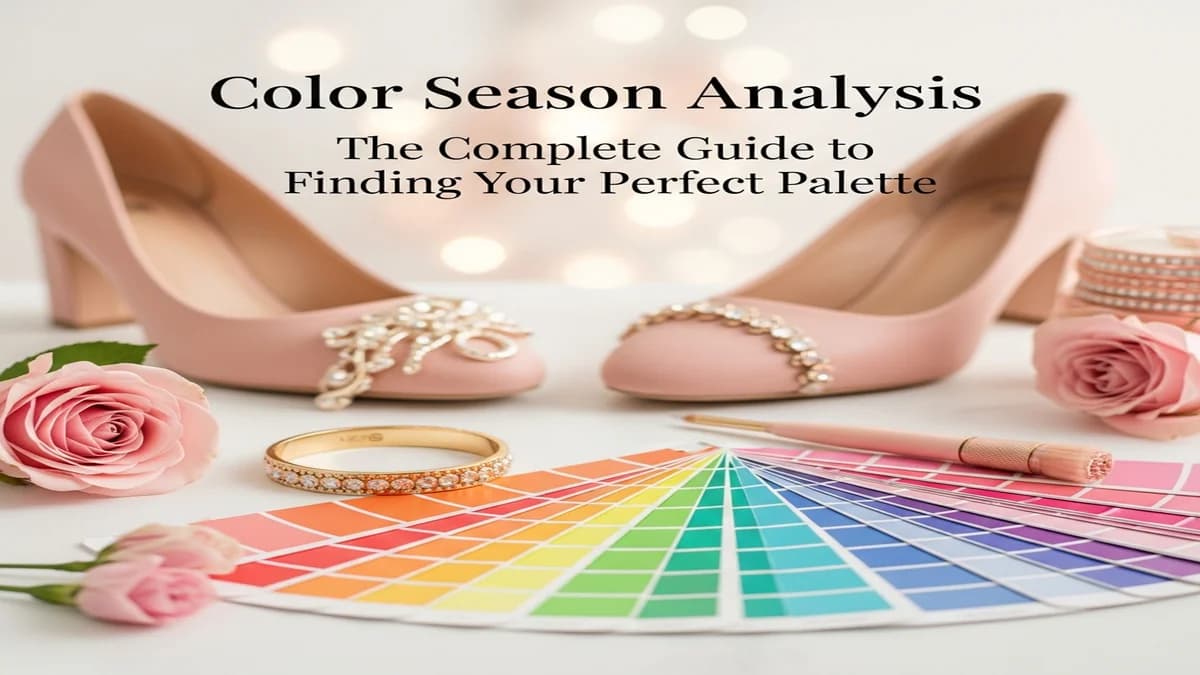
Seasonal Color Analysis: The Only Guide You Actually Need
I spent years buying clothes that looked incredible on the hanger and terrible on me. A dusty rose blouse that made my friend look luminous turned my skin the color of oatmeal. A gorgeous burnt orange sweater that I loved in theory washed me out so badly that a coworker asked if I was feeling okay.
Then I discovered seasonal color analysis — and it changed not just my wardrobe, but how I think about color entirely.
If you have ever wondered why certain shades make you look alive while others drain the life out of your face, this is the guide that explains it. No jargon overload. No hundred-dollar consultation required. Just a clear, honest walkthrough of what color seasons are, how to find yours, and how to actually use it in real life.
Want the quick answer? Take our free color season test and get your results in under a minute.
What Is Seasonal Color Analysis, Really?
At its core, seasonal color analysis is a way of figuring out which colors look best on you based on your natural coloring — specifically your skin undertone, your eye color, and your natural hair color.
The idea is simple: certain colors harmonize with your complexion and make you look healthier, more rested, more vibrant. Other colors clash with it and do the opposite. You know this intuitively already. You have shirts you reach for when you want to look good and shirts that sit in the back of your closet because something about them just feels off.
Color season analysis gives you a framework for understanding why.
The system groups people into four main categories named after the seasons — Spring, Summer, Autumn, and Winter — based on three traits:
- Undertone: whether the base of your skin leans warm (golden, peachy) or cool (pink, blue, olive-cool)
- Value: how light or dark your overall coloring is
- Chroma: how vivid or muted your natural coloring appears
Those three dimensions combine to place you in one of twelve specific sub-seasons, each with its own palette of roughly thirty to forty colors that work in harmony with your complexion.
A Brief History (Because It Is More Interesting Than You Think)
The roots of this system go back further than most people realize. In the 1920s, an American artist named Robert Dorr noticed that his paint-mixing students fell into two groups: some gravitated toward warm pigments and some toward cool. He called them "Key I" and "Key II" — the earliest version of warm versus cool typing.
Swiss color theorist Johannes Itten picked up the thread in the 1960s at the Bauhaus school. He observed that his art students instinctively chose palettes that echoed their own coloring — warm-toned students favored warm pigments, cool-toned students reached for blues and greys.
But the person who brought it to the masses was Suzanne Caygill, who spent decades from the 1940s through the 1970s developing a seasonal framework for personal color. Her work inspired Carole Jackson, whose 1980 book Color Me Beautiful became a phenomenon — selling millions of copies and launching a global industry of color consultants.
The original four-season system was elegant but limited. By the 1990s, consultants recognized that many people did not fit cleanly into one bucket. The 12-season expansion emerged to handle the in-between cases, and that is the system most professionals use today.
The Four Seasons (The Foundation)
Before we get into the twelve sub-seasons, you need to understand the four base types. Think of these as compass points — they give you direction even if your exact position lands between two of them.
Spring — Warm, Light, and Clear
Spring types have warm undertones and a certain brightness to their coloring. There is often a golden quality to the skin, and the eyes tend to be clear and vivid — bright blue, warm green, light hazel, or clear light brown.
Think of: Nicole Kidman's strawberry warmth, Emma Stone's peachy glow, Amy Adams with her copper hair and bright eyes.
The Spring palette is warm without being heavy. Coral, peach, warm pink, golden yellow, turquoise, light warm red, camel. These colors echo the warmth in your skin without overpowering it.
What to avoid: Black right up against your face (it creates too much contrast), cool icy pastels that fight your warmth, heavy burgundy that overwhelms your lightness. A Spring in head-to-toe black looks severe; a Spring in a warm camel coat looks like she is glowing from within.
Summer — Cool, Light, and Soft
Summer types are cool-toned and tend toward softness. The coloring is gentle — think ash blonde or mousy brown hair, blue or grey-blue eyes, pink or neutral-toned skin. There is a delicacy to Summer coloring that gets overwhelmed by bold or warm tones.
Think of: Cate Blanchett's ethereal coolness, Elle Fanning's soft blonde and blue-eyed palette, Emily Blunt's muted elegance.
The Summer palette is cool and muted. Dusty rose, lavender, powder blue, sage, mauve, soft navy, cool grey, heather. For a deeper look at cool-toned palettes, see our cool skin tone colors guide.
What to avoid: Warm orange (it will make you look jaundiced), bright golden yellow, warm olive green, and stark black (which overwhelms the softness). A Summer in orange looks unwell; a Summer in dusty rose looks like she just came back from the best vacation of her life.
Autumn — Warm, Deep, and Rich
Autumn types share Spring's warmth but with more depth and richness. The coloring tends to be earthier — golden olive skin, auburn or warm brown hair, amber or warm brown eyes. There is a natural richness that pairs beautifully with the deep, muted tones of the autumn landscape.
Think of: Julianne Moore's copper warmth, Jessica Alba's golden olive skin, Beyoncé's deep golden undertones.
The Autumn palette is warm and grounded. Terracotta, olive, rust, mustard, teal, warm brown, burnt orange, forest green, burgundy. These are the colors of a New England autumn — warm, complex, and deeply satisfying.
What to avoid: Icy pastels that feel disconnected from your depth, fuchsia that clashes with your warmth, bright white that creates an unnatural contrast. An Autumn in pastel pink looks like she grabbed the wrong person's jacket; an Autumn in olive green looks effortlessly put together.
Winter — Cool, Deep, and Bold
Winter types are the high-contrast, cool-toned dramatists of the color world. They can carry bold, saturated colors that would overwhelm every other season. Think dark hair against light skin, or very deep coloring throughout with cool undertones. The eyes are often intense — dark brown, icy blue, cool green.
Think of: Lupita Nyong'o's stunning contrast, Fan Bingbing's porcelain-and-raven combination, Dita Von Teese's cool-toned drama.
The Winter palette is bold and definitive. True red, emerald, royal blue, fuchsia, black, pure white, deep plum, icy lavender. These are colors that demand attention — and a Winter carries them effortlessly.
What to avoid: Warm earth tones that flatten your cool undertone, muted pastels that undercut your natural contrast, camel and warm brown that make you look muddy. A Winter in beige looks like she forgot to get dressed; a Winter in emerald green commands the room.
The 12-Season System: Finding Your Exact Match
Four seasons work as a starting point, but most of us are more nuanced than that. The twelve-season system accounts for the fact that coloring exists on a spectrum. Each base season gets three sub-types based on which trait dominates.
The Three Springs
Light Spring — Your warmth is delicate. You are the lightest of the warm types, with pale golden skin, light blonde or strawberry hair, and soft eyes. You share territory with Light Summer. Your sweet spot: peach, soft coral, warm pink, golden beige, light turquoise. Think watercolor warmth — beautiful but never heavy.
Warm Spring — The quintessential warm type. Everything about your coloring radiates warmth. Your sweet spot: salmon, tangerine, golden yellow, warm green, terracotta. You are the season that can pull off a marigold dress and look completely natural in it.
Bright Spring — You are warm but with a clear, vivid quality. Your eyes might be strikingly bright, your hair color saturated, your skin clear. You share territory with Bright Winter. Your sweet spot: bright coral, electric turquoise, vivid green, sunny yellow. You need color with some punch — muted tones fade on you.
The Three Summers
Light Summer — Cool-toned and ethereally light. You often have very fair skin, light ash hair, and pale blue or grey eyes. You share territory with Light Spring. Your sweet spot: lavender, powder pink, pale blue, soft grey, mint. You look best in colors that feel like a whisper rather than a shout.
Cool Summer — The most classically cool-and-muted season. Your coloring is clearly cool — no warmth anywhere. Your sweet spot: blue-based pink, cool rose, grey-blue, lavender, plum, teal. You are the person who looks incredible in a grey cashmere sweater when everyone else looks boring.
Soft Summer — Cool but notably muted. Your coloring has a gentle, almost smoky quality. You share territory with Soft Autumn. Your sweet spot: dusty teal, muted mauve, sage green, soft charcoal, mushroom. The most overlooked season — and one of the most elegant when you get the palette right.
The Three Autumns
Soft Autumn — Warm but gently so. Your coloring is muted and earthy without being dark. You share territory with Soft Summer. Your sweet spot: warm taupe, muted coral, olive, golden brown, soft teal. You are the season of cashmere and candlelight — warm but understated.
Warm Autumn — The deepest expression of warmth. Rich, saturated, unapologetically golden. Your sweet spot: pumpkin, rust, olive green, warm red, mustard, chocolate brown. You are the season that makes autumn in Vermont look like a personal tribute.
Deep Autumn — Warm and dark. You have significant depth to your coloring — dark hair, dark eyes, rich skin — with an unmistakable warm undertone. You share territory with Deep Winter. Your sweet spot: dark olive, auburn, warm burgundy, bronze, deep teal, espresso. Think of it as warmth turned up to full volume.
The Three Winters
Deep Winter — Cool and powerful. You have the deepest coloring of the cool types — dark everything with a cool or neutral-cool undertone. You share territory with Deep Autumn. Your sweet spot: black, dark navy, deep emerald, true red, dark purple. You carry drama as effortlessly as most people carry a handbag.
Cool Winter — The clearest expression of cool. Everything about your coloring is definitively cool-toned, with a certain crispness. Your sweet spot: true blue, fuchsia, icy pink, emerald, purple, stark black and white. You look best in colors that are definitive — no ambiguity, no muddy middle ground.
Bright Winter — Cool with an electric quality. Your coloring is vivid and high-contrast — think dark hair against fair skin with intensely colored eyes. You share territory with Bright Spring. Your sweet spot: hot pink, royal blue, bright purple, true red, bold black-and-white contrast. You are the person who can wear neon and look sophisticated rather than costumey.
How to Determine Your Color Season at Home
You do not need to spend three hundred dollars on a draping session to figure out your season. Here is how to do it yourself with reasonable accuracy.
Step 1: Find Your Undertone
This is the most important step and the one people get wrong most often. Your undertone is not the same as your skin shade. A person with porcelain skin can be warm-toned, and a person with deep espresso skin can be cool-toned. Depth and undertone are completely separate things.
The vein test: Look at the veins on the inside of your wrist in natural light. Green veins suggest warm undertones. Blue or purple veins suggest cool. If you see a mix, you likely have neutral undertones — which means you will lean toward one of the transitional sub-seasons.
The jewelry test: Hold a piece of gold jewelry and a piece of silver jewelry against your face, one at a time. If gold makes you glow, you are warm. If silver does, you are cool. If both look equally good, you are neutral.
The draping test: Hold a warm-toned fabric (think terracotta, golden yellow) and a cool-toned fabric (think icy pink, blue-grey) near your face. Watch what happens to your skin. The right temperature makes your skin look smoother and more even. The wrong one highlights every imperfection and shadow.
One important note: do these tests in natural daylight, without makeup, and ideally next to a window. Artificial lighting skews warm and will make everything look golden.
Step 2: Assess Your Value — Light or Dark?
Look at your overall coloring — hair, skin, and eyes as a package. Are you generally light-toned throughout, or is there significant depth? This narrows your options.
Light overall coloring points toward Light Spring or Light Summer. Dark overall coloring points toward Deep Winter or Deep Autumn. If you are somewhere in between, other factors will determine your season.
Step 3: Muted or Vivid?
This is the dimension that trips people up the most. Look at your features in a mirror. Are your eyes a striking, vivid color — bright green, icy blue, intensely dark? Or are they soft and blended — grey-green, muddy hazel, soft brown? Is the contrast between your hair, skin, and eyes dramatic or gentle?
If vivid and high-contrast: you are a Bright or Clear type (Bright Spring, Bright Winter, or one of the Deep seasons).
If soft and blended: you are a Soft or Muted type (Soft Summer, Soft Autumn, or one of the Light seasons).
Step 4: Put It Together
Cross-reference your three answers:
- Warm + light + clear = Light Spring or Warm Spring
- Warm + deep + muted = Soft Autumn or Warm Autumn
- Warm + deep + clear = Deep Autumn
- Cool + light + soft = Light Summer or Soft Summer
- Cool + deep + clear = Deep Winter or Cool Winter
- Cool + vivid = Bright Winter or Cool Winter
If you land between two options, try both palettes and see which one gets more compliments. Seriously — the "which colors get me the most compliments" test is surprisingly reliable.
The Faster Way
If all of this sounds like more work than you want to do on a Tuesday afternoon, take our AI color season test. Upload a well-lit photo in natural light without makeup and you get your season plus a personalized palette in under a minute. It is not a replacement for a professional draping session, but for most people it gets the answer right.
How to Actually Use Your Color Season
Knowing your season is only useful if you do something with it. Here is how to apply it to the parts of your life where color matters.
Your Wardrobe
You do not need to throw out everything that is not in your palette. The biggest impact comes from what you wear near your face — tops, scarves, jackets, jewelry. A Spring can wear cool-toned pants because they are far from the face, but a warm-toned blouse near the complexion makes a real difference.
Start with your core neutrals. Every season has its own version of neutral:
- Spring: Camel, warm grey, ivory, golden tan
- Summer: Cool grey, soft navy, taupe, stone
- Autumn: Chocolate brown, olive, warm khaki, deep camel
- Winter: Black, charcoal, navy, pure white
Build your basics in your season's neutrals, then add accent colors from your palette. This approach means everything in your closet works together, which also simplifies getting dressed.
For ideas on how color season pairs with body-flattering choices, see our guide on best hairstyles for face shape — the same principle of working with your natural features rather than against them applies.
Makeup
Your color season simplifies makeup shopping enormously.
Foundation: Season does not change your shade but knowing warm versus cool helps you pick the right undertone in foundation. Warm seasons need yellow-based formulas, cool seasons need pink-based ones. Getting this right makes everything else look better.
Lipstick by season:
- Spring: Peach, warm coral, warm nude, terracotta
- Summer: Dusty rose, mauve, cool pink, berry
- Autumn: Warm red, cinnamon, deep coral, brick
- Winter: True red, berry, fuchsia, deep plum
Blush by season:
- Spring: Peach, soft coral, warm pink
- Summer: Dusty rose, cool pink, light mauve
- Autumn: Terracotta, warm apricot, burnt sienna
- Winter: Cool pink, berry, true rose
Eyeshadow by season:
- Spring: Warm bronze, peach, golden brown, warm taupe
- Summer: Cool taupe, dusty rose, plum, slate blue
- Autumn: Copper, olive, warm brown, russet
- Winter: Charcoal, silver, deep plum, steel blue
Hair Color
This is where color season analysis saves people from expensive mistakes. Going against your season's undertone with hair color is one of the most common reasons a new color looks "wrong" even when the shade itself is pretty.
- Springs thrive with golden blonde, strawberry tones, warm caramel, and light copper. Cool ash tones tend to look flat.
- Summers look best in ash blonde, cool brown, platinum, and mushroom brown. Golden highlights can look brassy.
- Autumns glow in auburn, warm chocolate, copper, and rich caramel. Ashy or icy tones fight the warmth.
- Winters carry cool dark brown, blue-black, espresso, and — if they want contrast — platinum blonde. Warm golden tones look unnatural.
Nail Polish
Your seasonal palette extends to your nails. This matters more than most people realize because your hands are always visible.
- Spring nails: Coral, peach, warm pink, golden nude, turquoise
- Summer nails: Lavender, dusty rose, cool pink, mauve, soft grey
- Autumn nails: Olive, terracotta, burgundy, warm brown, forest green
- Winter nails: True red, deep plum, emerald, bright fuchsia, classic black
For seasonal nail inspiration, our spring nail colors by skin tone guide goes deep on matching nail shades to your coloring.
Jewelry and Accessories
The metal rule is straightforward and makes a bigger difference than most people expect:
- Warm seasons (Spring, Autumn): Gold, rose gold, copper, brass
- Cool seasons (Summer, Winter): Silver, platinum, white gold
Neutral sub-seasons (those that bridge warm and cool) can wear either, but one will always look slightly more natural.
Common Mistakes That Trip People Up
After eight years of working with color analysis — and making most of these mistakes myself — here are the ones I see over and over.
Confusing skin shade with undertone. This is the biggest one. Your skin can be deep ebony or porcelain fair — that is your shade, not your undertone. A dark-skinned person can be a Spring (warm undertone) or a Winter (cool undertone). Undertone is about the underlying hue, not the surface color. For more on colors that work with dark skin tones, we have a separate guide.
Testing under artificial light. Most indoor lighting is warm-toned, which makes everything look golden. Do your undertone tests near a window in daylight. If you test under tungsten bulbs, you will probably type yourself as warm even if you are cool.
Using your dyed hair color. Your color season is based on your natural hair color. If you have been coloring your hair for years, try to remember what your natural shade was — or look at childhood photos. Dyed hair changes the colors that look good near your face, but your season is still determined by the coloring you were born with.
Thinking one palette fits forever. Your season stays the same, but your sub-season can drift. Gray hair, in particular, shifts many people from their deep sub-season to their light or cool sub-season. A Deep Autumn who goes fully silver might find they now sit more comfortably in Cool Summer territory. Reassess every few years.
Being too rigid. Color season analysis is a tool, not a prison. If you adore a color that is technically not in your palette, wear it. You can often make it work by keeping it further from your face — as pants, a skirt, or a bag rather than a top — or by pairing it with a harmonizing color from your actual palette.
Does Color Season Analysis Work for Men?
One hundred percent. The principles are identical — undertone, value, and chroma apply regardless of gender. Men just tend to apply it differently: suit colors, shirt and tie combinations, casual wear, and grooming.
We wrote a complete color analysis for men guide that covers the specific applications. The short version: if you have ever owned a shirt that gets you compliments every time you wear it, it is almost certainly in your seasonal palette. Color analysis just tells you why.
Does This Really Work? The Science Behind It
Color season analysis is built on real color theory that artists and designers have used for centuries. The key principle is simultaneous contrast — when two colors sit next to each other, they each influence how the other one looks. A color that harmonizes with your skin makes your complexion appear clearer, your eyes brighter, your overall appearance more vital. A clashing color does the reverse.
This is not vague aesthetic preference. Researchers in cosmetic science have demonstrated that certain color combinations measurably affect how healthy and attractive skin appears to observers. It is the same principle that interior designers use when choosing paint colors and that film colorists use when grading scenes — color relationships matter.
The practical proof is simpler: try on a top in your best color and one in your worst. Look at your face — not the clothes. In one, your skin looks even and your features pop. In the other, you notice dark circles, redness, and unevenness you didn't see a moment ago. Same face, different framing.
Building a Capsule Wardrobe Around Your Season
Once you know your season, building a capsule wardrobe becomes dramatically easier. Instead of a closet full of things that do not quite go together, you end up with a collection where everything matches because it is all drawn from the same harmonious palette.
Start with fifteen to twenty core pieces in your seasonal neutrals: a couple of jackets, several tops, two or three pairs of pants, a dress or two, a coat. Then add five to ten accent pieces in your best colors — the statement blouse, the bold scarf, the standout dress.
The result is a wardrobe that is smaller but more functional, where you genuinely love wearing everything in it.
Finding Your Color Season with AI
Traditional color analysis means booking a session with a certified consultant who holds dozens of fabric swatches against your face to see what happens. It is thorough, it is personal, and it costs between one hundred fifty and four hundred dollars for a session.
AI analysis offers a complementary approach. Upload a photo taken in good natural light — no makeup, no filters — and the AI maps your coloring against thousands of reference profiles to identify your season and sub-season. You get a personalized palette you can save to your phone and reference while shopping.
Is the AI as nuanced as an expert human consultant? Not always. Edge cases — people who sit right between two sub-seasons, or people with unusual coloring combinations — benefit from professional eyes. But for the majority of people, the AI gets it right, and it gets it right in sixty seconds for free.
Once you know your season, understanding your warm skin tone colors or cool skin tone colors in depth becomes the natural next step. And for personalized skincare that complements your coloring, our AI skin analysis can build a routine tailored to your specific skin.
The bottom line: color season analysis is one of those rare beauty tools that actually simplifies your life. Fewer wrong purchases, less time getting dressed, more confidence that what you are wearing is working for you rather than against you. It is not about following rules — it is about understanding what makes you look like the best version of yourself.
Frequently Asked Questions
What is seasonal color analysis?▼
Seasonal color analysis is a system that matches your natural coloring — your skin undertone, eye color, and hair color — to a palette of colors that make you look healthier and more vibrant. It divides people into four main groups named after the seasons (Spring, Summer, Autumn, Winter), each with three sub-types for a total of 12 specific palettes. The idea is grounded in color theory: certain hues harmonize with your complexion while others clash with it.
How do I determine my color season?▼
Start by figuring out your undertone. Check the veins on your inner wrist in daylight — green veins suggest warm undertones, blue or purple veins suggest cool. Then hold gold and silver jewelry near your face and see which one makes your skin glow. Once you know warm or cool, look at your overall lightness versus depth and whether your coloring is muted or vivid. That combination points to your season. You can also take our free AI color season test for instant results.
What are the 4 color seasons?▼
Spring is warm and bright — think coral, peach, and golden yellow. Summer is cool and soft — lavender, rose pink, powder blue. Autumn is warm and rich — olive, rust, camel, mustard. Winter is cool and bold — navy, emerald, true red, fuchsia. Each one reflects how your natural coloring interacts with different hues.
Can your color season change over time?▼
Your core season almost never changes because it is based on your skin undertone, which stays the same throughout your life. What can shift is your sub-season. As your hair grays or your skin changes with age, you might move from Deep Autumn to Soft Autumn, for example. But the warm-versus-cool foundation stays put.
What if I fall between two color seasons?▼
Most people do. The 12-season system exists precisely because four buckets are not enough. If you are between two seasons, focus on the colors where those palettes overlap — those shades will always work for you. For instance, someone between Light Spring and Light Summer looks great in soft peach, powder pink, and warm pastels that sit at the boundary.
How accurate is AI color season analysis?▼
Modern AI color analysis is remarkably accurate when you provide a clear photo taken in natural daylight without makeup or filters. Our AI analyzes subtle undertone cues, contrast levels, and color temperature across thousands of reference points. For most people the result matches what a professional color consultant would find. It is not perfect for every edge case, but it gives you a strong starting point.
What colors should I avoid for my color season?▼
Each season clashes with specific tones. Springs look washed out in cool black and icy pastels. Summers get sallow in warm orange and golden brown. Autumns lose their warmth in bright fuchsia and stark white. Winters look dull in muted earth tones and camel. The clashing colors are basically the palette of your opposite season.
Does seasonal color analysis work for dark skin tones?▼
Absolutely. Color season analysis is about undertone and contrast, not skin depth. A person with deep ebony skin can be a Winter (cool undertone, high contrast) or an Autumn (warm undertone, rich depth) just as easily as someone with fair skin. Every ethnicity and skin depth has representation across all four seasons and all 12 sub-seasons.
How do I use my color season for makeup?▼
Use your season as a starting filter. Springs reach for peach blush, warm coral lipstick, and golden bronze eyeshadow. Summers suit dusty rose, mauve lips, and taupe eyes. Autumns glow in terracotta blush, warm red lips, and copper eyeshadow. Winters pop with cool pink blush, berry lips, and smoky charcoal eyes. Your foundation undertone — yellow-based for warm seasons, pink-based for cool — is the most important piece.
Can I wear black if I am not a Winter?▼
You can always wear black — it is a wardrobe staple for a reason. But if you are a Spring or Autumn, soften it by pairing black with warm accessories near your face, or try charcoal or deep navy instead. Summers can break up black with cool-toned layers. The point is not to ban colors but to know which ones need a little more intention.
What is the difference between the 4-season and 12-season color system?▼
The 4-season system divides everyone into Spring, Summer, Autumn, or Winter based on warm-versus-cool and light-versus-dark. The 12-season system adds nuance by splitting each season into three sub-types based on which trait dominates — for example, Autumn becomes Soft Autumn, Warm Autumn, and Deep Autumn. The 12-season approach is more precise and helps the many people who never quite fit a single basic season.
How much does professional color analysis cost?▼
An in-person session with a certified color consultant typically runs between 150 and 400 dollars and lasts one to two hours. Online consultations are cheaper, usually 50 to 150 dollars. AI-based tools like GlowAI offer instant analysis for free, which gives most people a reliable starting point before deciding whether to invest in a professional draping session.
Discover Your Color Season
Find the colors that make you glow with our AI-powered color analysis.
Join 10,000+ beauty enthusiasts. Unsubscribe anytime.
Was this article helpful?
Continue Your Beauty Journey
Warm Skin Tone Colors: The Best Shades for Clothing, Makeup & Hair (2026)
Discover the best colors for warm skin tones — clothing, makeup, nails, and hair. See exactly which warm-tone shades complement golden undertones and which to avoid.
Couleurs pour les peaux froides : guide complet des teintes flatteuses
Les meilleures couleurs pour les peaux à sous-ton froid — vêtements, maquillage, ongles et bijoux. Guide pratique sans fioritures.
Best Spring Nail Colors for Your Skin Tone: A Complete Guide
Spring nail colors for every skin tone — pastels, glazed chrome effects, and AI-matched shades for 2026. Find your perfect palette today.