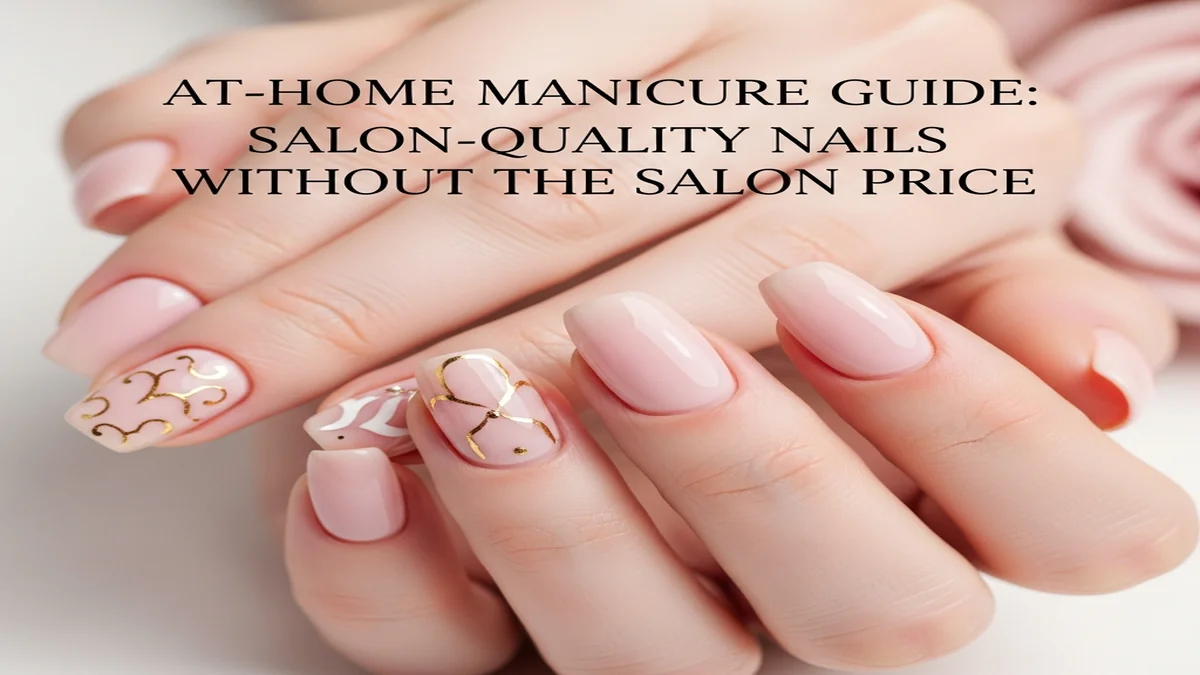
At-Home Manicure Guide: Salon-Quality Nails Without the Salon Price
A professional manicure costs $25-50 per visit, and if you go every two weeks, that adds up to $650-1,300 per year. An at-home manicure using the same techniques professionals use delivers the same results for a fraction of the cost. Once you learn the process, it takes about 30-45 minutes and your polish will last just as long as a salon application.
This step-by-step guide covers everything from nail prep through polish application to cleanup and maintenance.
What You Need
Essential Tools
- Nail clippers
- Glass or crystal nail file (gentler than metal or cardboard)
- Cuticle pusher (wooden orange stick or rubber-tipped pusher)
- Nail buffer (4-sided buffing block)
- Small bowl for soaking
- Cotton pads or rounds
- Nail polish remover (acetone-free preferred)
- Paper towels or old towel
Essential Products
- Base coat
- Nail polish (your chosen color)
- Top coat
- Cuticle oil
- Hand cream
- Cuticle remover solution (optional but helpful)
Nice-to-Have
- Cleanup brush (small, angled brush for correcting mistakes)
- Nail corrector pen
- Quick-dry drops or spray
- Nail art tools (dotting tool, striping brush)
- UV/LED lamp (for gel polish)
Step-by-Step Manicure Process
Step 1: Remove Old Polish (2 Minutes)
Start with clean nails. Soak a cotton pad in nail polish remover and press it against the nail for 5-10 seconds before wiping. This allows the remover to dissolve the polish rather than requiring aggressive rubbing that can damage the nail surface.
For glitter or dark polish: Soak a cotton pad in remover, wrap it around the nail, and hold for 30 seconds before wiping. The extra soak time dissolves stubborn polish completely.
Wash hands after removing polish to eliminate any remover residue.
Step 2: Shape Your Nails (3-5 Minutes)
Trim nails to your desired length with nail clippers if needed, then file to refine the shape.
Filing rules:
- File in ONE direction only (not back and forth). Sawing creates micro-tears in the nail layers that lead to peeling and splitting.
- Use a glass or crystal file. These are gentler than metal files and create a smoother edge.
- Hold the file at a slight angle under the nail edge, not straight across.
- Use light, sweeping strokes. Let the file do the work.
Choose your shape: Round, square, squoval (square with rounded corners), oval, or almond. For guidance on which shape suits your hands, see our nail shape guide.
Shape tip: File each side of the nail, then the center, checking symmetry as you go. Both hands should match.
Step 3: Soak and Soften (5 Minutes)
Fill a small bowl with warm water and add a few drops of cuticle oil or hand soap. Soak fingertips for 3-5 minutes to soften cuticles and skin around the nails.
This step makes cuticle work easier and less aggressive. Skipping it means you have to push harder, which risks damaging the cuticle and nail matrix.
Step 4: Cuticle Care (5 Minutes)
Remove hands from water and pat dry.
Option A: With cuticle remover solution
- Apply cuticle remover solution around each cuticle
- Wait 1-2 minutes as directed
- Gently push cuticles back with orange stick at 45-degree angle
- Wipe away dissolved dead skin with cotton pad
- Rinse hands
Option B: Without cuticle remover
- While cuticles are still soft from soaking, gently push back with orange stick
- Use the flat edge to sweep away any loose dead skin from the nail plate
- Be gentle — you are repositioning, not scraping
Important: Do not cut cuticles. Cutting creates open wounds that risk infection and leads to thicker regrowth. Pushing back and removing dead skin is sufficient for a clean look.
Trim only true hangnails (loose, dead skin tags) with sharp cuticle nippers. Cut at the base of the hangnail without tearing.
Step 5: Buff the Nail Surface (2 Minutes)
Using a 4-sided nail buffer:
- Coarse side: Gently smooth out any ridges or rough spots on the nail surface. Use light pressure and only a few strokes. Do not over-buff, which thins the nail.
- Medium side: Refine the surface.
- Fine side: Create a smooth base for polish.
- Shine side (optional): If going polish-free, this side creates a natural shine. Skip if applying polish (a slightly textured surface helps polish adhere better).
Caution: Do not buff aggressively or frequently. Buffing removes thin layers of nail. Once every 2-4 weeks is sufficient. If your nails are already thin, skip this step.
Step 6: Clean the Nail Surface (1 Minute)
Wash hands thoroughly with soap and water to remove all oils, dust, and residue from filing and buffing.
Dry hands completely. Then swipe each nail with a cotton pad dampened with nail polish remover or rubbing alcohol. This removes any remaining oils that would prevent polish from adhering.
Critical step: Oils on the nail surface are the number one cause of polish peeling and chipping prematurely. This degreasing step dramatically improves polish longevity.
Step 7: Apply Base Coat (2 Minutes)
Apply one thin, even coat of base coat to all 10 nails.
Application technique:
- Dip the brush and wipe one side against the bottle neck to remove excess
- Place the brush in the center of the nail, slightly above the cuticle
- Push the brush gently toward the cuticle (leaving a tiny gap between polish and cuticle)
- Pull the brush in one smooth stroke to the free edge
- Repeat on each side of the nail (left stripe, right stripe)
- Three strokes total: center, left, right
Why base coat matters:
- Prevents polish from staining your natural nail (especially important with red and dark colors)
- Creates a smooth, even surface for color
- Helps polish adhere better and last longer
- Contains nail-nourishing ingredients in many formulas
Allow base coat to dry for 1-2 minutes before proceeding.
Step 8: Apply Color (5-10 Minutes)
Apply two thin coats of your chosen nail polish color.
First coat technique:
- Same three-stroke method as base coat
- Keep coats thin. Thick coats bubble, take forever to dry, and smudge easily.
- It is okay if the first coat looks streaky or uneven. The second coat will even it out.
- Leave a tiny gap at the cuticle and side walls (cap the free edge for longevity)
- Allow the first coat to dry for 2-3 minutes
Cap the free edge: After each stroke across the nail, run the brush lightly across the very tip of the nail. This seals the edge and prevents chipping from the tip.
Second coat technique:
- Apply the same way as the first coat
- This coat should provide full, even coverage
- Allow to dry for 3-5 minutes before top coat
For sheer or light colors: You may need a third thin coat for full opacity. Always thin coats, never thick.
Step 9: Apply Top Coat (2 Minutes)
Apply one generous (but not thick) coat of top coat over the fully dried color.
Top coat functions:
- Adds shine and glossiness
- Protects the color from chipping and fading
- Extends the life of your manicure by 3-5 days
- Provides UV protection (some formulas prevent yellowing)
Cap the free edge again with top coat for maximum chip protection.
Quick-dry top coat: If you are short on time, quick-dry top coats set the surface within 1-2 minutes. However, the layers underneath may still be vulnerable to denting for up to an hour.
Step 10: Clean Up (2 Minutes)
No matter how careful you are, some polish will end up on the skin around your nails.
Cleanup technique:
- Dip a small, angled brush in nail polish remover
- Carefully trace along the cuticle and side walls, removing any stray polish
- The angled brush gives precision that a cotton swab cannot match
Alternative: Wait until polish is mostly dry, then take a warm shower. The steam softens stray polish on the skin, which peels off easily.
Step 11: Hydrate and Finish (2 Minutes)
Once polish is fully dry (wait at least 15-20 minutes, or longer for regular polish):
- Apply cuticle oil around each cuticle
- Massage in gently
- Apply hand cream to hands and wrists
The cuticle oil nourishes the cuticles and surrounding skin, and it adds a beautiful, healthy glow to your finished manicure.
Making Your Manicure Last
A well-applied at-home manicure should last 5-10 days. Maximize longevity with these habits:
Apply top coat every 2-3 days. A fresh layer of top coat refreshes the shine and adds another protective layer. This single habit can extend your manicure by 3-5 extra days.
Wear gloves for cleaning and dishes. Water and chemicals are the biggest threats to polish longevity.
Avoid using nails as tools. Opening cans, peeling stickers, and scratching surfaces chip polish and damage nails.
Apply cuticle oil daily. This keeps cuticles looking neat and maintains the polished, healthy appearance of your manicure.
Avoid hot water on fresh nails. For the first few hours after application, avoid hot showers, baths, or dish washing. Heat softens polish and makes it more prone to denting and smudging.
Common At-Home Manicure Mistakes
Thick coats. The single most common mistake. Thick coats bubble, take 30+ minutes to dry, and smudge easily. Always apply thin coats and build coverage with multiple layers.
Skipping base coat. Without base coat, polish stains the nail, adheres poorly, and chips faster. The extra minute of application pays off in longevity.
Shaking the bottle. Shaking introduces air bubbles into the polish that transfer to the nail. Instead, roll the bottle between your palms to mix the polish without creating bubbles.
Not capping the free edge. Polish chips fastest from the nail tip. Running the brush across the tip with each coat seals the edge and prevents premature chipping.
Applying polish to oily nails. Natural oils on the nail surface prevent polish from bonding. Always clean and degrease nails before application.
Moving hands while polish is wet. Fanning, blowing, or waving hands while polish is wet does not speed drying (it can actually create bubbles) and risks smudges.
Not waiting between coats. Applying the next coat before the previous one has set leads to bubbling, dragging, and uneven coverage. Wait 2-3 minutes between each coat.
At-Home Gel Manicure
For longer-lasting results (2-3 weeks), you can do gel manicure at home with a UV or LED lamp:
Additional supplies needed:
- UV or LED nail lamp
- Gel base coat, color, and top coat
- Alcohol wipes or gel cleanser (for the sticky inhibition layer)
- Gel polish remover or pure acetone
Process differences:
- Each layer (base, color, top) is cured under the lamp instead of air drying
- Cure times depend on the lamp (LED: 30-60 seconds, UV: 2 minutes per coat)
- Apply thinner coats than regular polish (gel self-levels but can flood cuticles if too thick)
- Cap the free edge with every coat
Removal: Gel must be properly removed by soaking in acetone. Do not peel gel off — this removes layers of the natural nail plate.
Budget Manicure Kit
You do not need expensive products for great results. A complete at-home kit can be assembled for under $30:
Basic starter kit ($15-25):
- Glass nail file ($5-8)
- Cuticle pusher/orange sticks ($2-3)
- Base coat ($4-6)
- Top coat ($4-6)
- 1-2 nail polish colors ($3-5 each)
- Cuticle oil ($3-5)
This kit will last months and pay for itself after skipping just one salon visit.
For choosing the most flattering nail colors based on your skin tone, check out our guide to nail colors for your skin tone. And for personalized beauty recommendations, try GlowAI's AI analysis to discover your color profile.
Frequently Asked Questions
How do I do a professional manicure at home?▼
Start by removing old polish, shaping nails with a fine-grit file, soaking hands in warm soapy water for five minutes, pushing cuticles gently, buffing nail surfaces, applying base coat, two thin color coats, and finishing with a glossy top coat.
What tools do I need for an at-home manicure?▼
Essential at-home manicure tools include a nail file, cuticle pusher, cuticle oil, nail buffer, base coat, your chosen polish color, top coat, cotton pads, and nail polish remover. A UV lamp is needed only for gel manicures.
How long does an at-home manicure last?▼
A well-done at-home manicure with regular polish lasts five to seven days. Using a quality base and top coat extends wear. Gel manicures at home can last two to three weeks with proper curing and sealing.
How do I prevent chipping after an at-home manicure?▼
To prevent chipping, always apply a base coat, use thin layers of polish, cap the free edge with each coat, and finish with a durable top coat. Reapply top coat every two days and wear gloves during household chores.
Can I do gel nails at home?▼
Yes, gel nails at home require a UV or LED lamp, gel base coat, gel color, and gel top coat. Cure each layer under the lamp as directed. Proper application gives salon-quality results that last two to three weeks.
How do I remove gel polish at home safely?▼
Buff the shiny top layer lightly, soak cotton pads in acetone, wrap each nail with foil, wait 10 to 15 minutes, then gently scrape off the gel with a cuticle pusher. Follow with cuticle oil to rehydrate your nails.
What is the best nail shape for an at-home manicure?▼
Rounded and squoval shapes are easiest for at-home manicures because they require less precision than stiletto or coffin shapes. File in one direction only to prevent splitting and maintain a smooth, even shape.
How often should I do an at-home manicure?▼
Do an at-home manicure every one to two weeks to keep nails looking polished. Between sessions, apply cuticle oil daily and moisturize hands regularly to maintain nail health and prevent dryness.
Get Your Free AI Skin Analysis
Upload a selfie and get personalized skincare recommendations powered by AI.
Join 10,000+ beauty enthusiasts. Unsubscribe anytime.
Was this article helpful?
Continue Your Beauty Journey

Nail Shape Guide 2026: Find the Best Shape for Your Hands
Nail shape guide — find the best shape for your hands and lifestyle. From almond to coffin, compare all options for 2026.
Best Spring Nail Colors for Your Skin Tone: A Complete Guide
Spring nail colors for every skin tone — pastels, glazed chrome effects, and AI-matched shades for 2026. Find your perfect palette today.
Nail Strengthening Routine: How to Fix Weak, Brittle, and Peeling Nails
Nail strengthening routine to fix weak, brittle, and peeling nails. Daily care steps and the best products. Start today.